
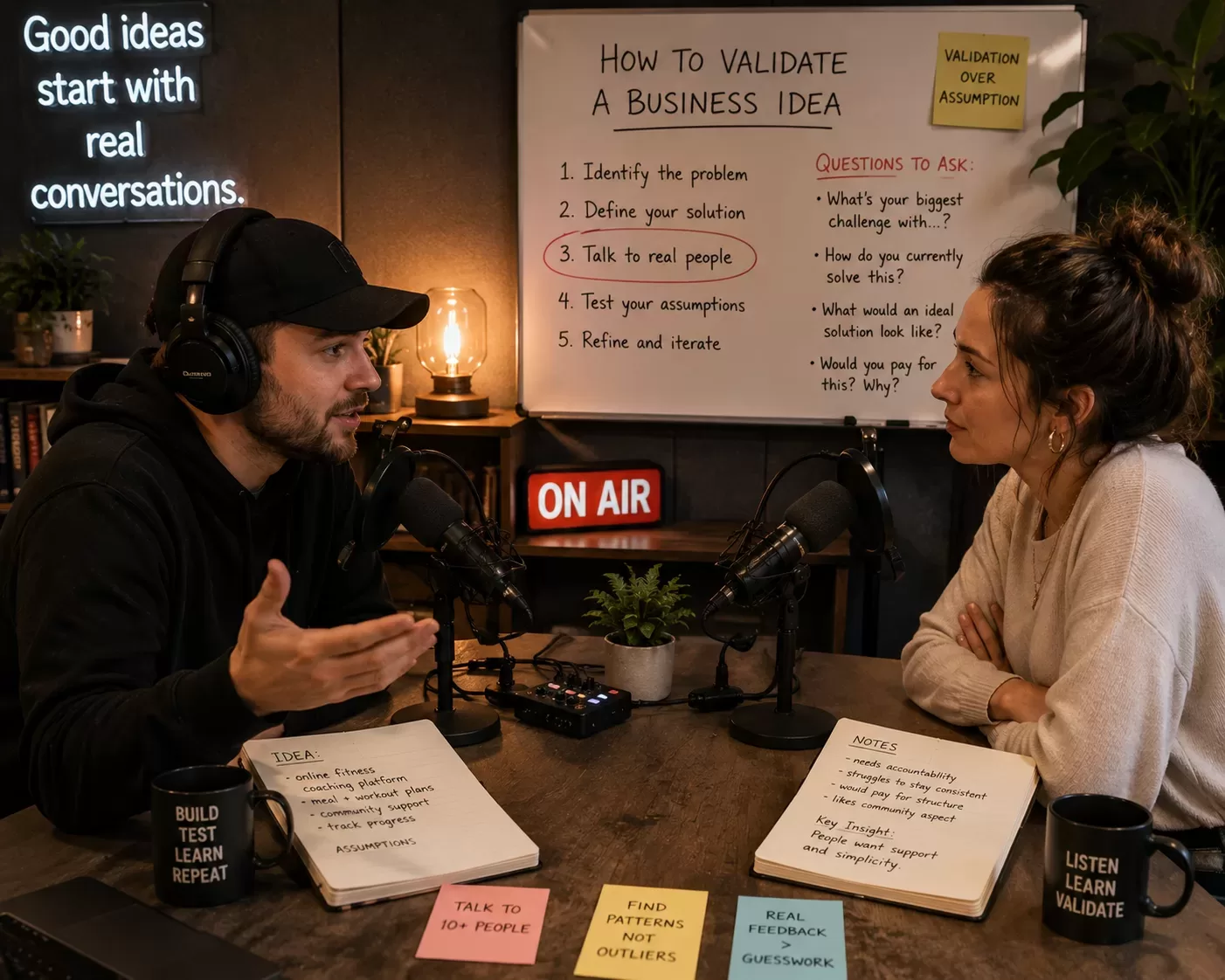
Most online businesses that fail don't fail because of a bad website, weak marketing, or even a bad idea. They fail because nobody checked whether the idea had real demand before months of work went into building it. Validation is how you find that out early — while it still only costs you days or a small amount of money, instead of a year of your life.
Validating an idea isn't about proving yourself right. It's about reducing risk before you invest serious time, money, and energy into something nobody actually wants.
What You're Actually Testing
"Validation" sounds abstract, but it breaks down into three concrete questions:
- Is the problem real? Are people actually bothered enough by this to do something about it — not just mildly interested?
- Can you reach the audience? Do you know where these people spend time online, and can you get in front of them without a massive budget?
- Does demand exist at a price? Will people actually pay — or take a real action, like joining a waitlist with their card details — before you've built anything?
You don't need a finished product to answer any of these. You need signals that cost the other person something — time, effort, reputation, or money. "That's a great idea!" from a friend costs nothing and tells you nothing.
Validation Methods That Actually Work
1. Problem Interviews
Talk to at least 10–15 people who might have the problem you think you're solving. The goal isn't to pitch your idea — it's to understand how they currently deal with the problem, what they've already tried, and how much it actually bothers them. If people struggle to describe the problem in their own words, or they've never tried to solve it, that's a signal to slow down.
2. A Landing Page or Demand Test
Build a single page that describes the offer as if it already exists, with a clear call to action — "Join the waitlist," "Pre-order," or "Get early access." Send a small amount of traffic to it (organic posts, a small ad budget, or your existing network) and see whether real people take the action. A page that converts even a modest percentage of cold traffic is a far stronger signal than any survey.
3. Pre-Selling
This is the strongest validation signal available: get people to pay before the thing exists. That can mean pre-orders, a deposit for a service, or a founding-member price for a product still in development. Money changing hands tells you more in one week than months of "what do you think" conversations.
4. A Manual, Unscalable Version First
Before building software or automating anything, do the work by hand for a handful of customers — deliver the service yourself, assemble the product manually, answer every message personally. It's slower, but it tells you exactly what people value (and don't) before you've written a line of code or ordered inventory.
Signals to Be Skeptical Of
Some "validation" doesn't actually validate anything, and it's easy to mistake encouragement for evidence:
- Friends and family enthusiasm. People close to you want to be supportive, not accurate.
- Hypothetical survey questions. "Would you buy this?" gets wildly optimistic answers compared to what people actually do when a real price is in front of them.
- Social media likes and comments. Engagement on a post about your idea doesn't mean anyone would pay for it.
- Praise without a follow-up question. If nobody asks "when can I get this?" or "how much is it?", the interest is probably polite, not real.
A Simple Validation Timeline
You don't need months. A focused validation pass can realistically run one to three weeks:
- Days 1–3: Write down the specific problem and who has it. Draft a one-sentence description of the offer.
- Days 4–7: Run 8–15 problem interviews with people outside your immediate circle.
- Days 8–12: Build a simple landing page or offer page and drive some traffic to it.
- Days 13–21: Attempt to pre-sell, take deposits, or deliver a manual version to your first few customers.
When You've Validated Enough
You never eliminate risk entirely, and waiting for certainty is its own way of never starting. A reasonable bar: you've talked to real people who clearly have the problem, you have some evidence — not just opinions — that they'd pay for a solution, and you understand at least roughly what it would take to deliver it. Once you're there, the honest move is to build a scoped first version and keep testing with real customers, not to keep validating indefinitely.
This article is general education, not personalized business, financial, or legal advice. Results vary widely based on market, execution, and circumstances outside any framework's control.
Ready for the next step? Explore the Start stage for more on planning your launch and understanding startup costs.